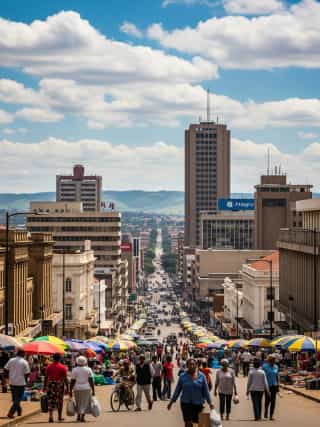
Harare - The Capital of Zimbabwe
- Population
- 1,606,000
- Language
- English
- Continent
- Africa
- Since
- 1980
- Eco Ranking
- 51/195
Source: Environmental Performance Index 2024.
About Harare
Harare was established in 1890 as Fort Salisbury by British South Africa Company forces, serving as the administrative center of Rhodesia under British colonial authority. It was known as Salisbury until 1982, when it was renamed Harare after independence from Britain in 1980, taking its name from a Shona chief. The transition to majority rule and independence marked the city's transformation from a colonial capital to the capital of Zimbabwe under Robert Mugabe, who led the country from 1980 to 2017. Under Mugabe's extended rule, Harare suffered severe economic deterioration. Zimbabwe's hyperinflation crisis, which peaked in 2008 when annual inflation was estimated in the hundreds of millions of percent, devastated the city's infrastructure, public services, and population. Water supply failures, power outages, and the collapse of the healthcare system became characteristic of daily life in the capital. Mugabe was removed in a military-assisted transition in November 2017 and replaced by Emmerson Mnangagwa. Harare houses the Parliament of Zimbabwe, the Office of the President, and the Supreme Court. Despite its political centrality, the city's infrastructure remains substantially degraded from its pre-crisis peak. Harare gave its name to the Harare Declaration of 1991, which established the modern principles of the Commonwealth of Nations.
About Zimbabwe
Zimbabwe is a presidential republic in southern Africa governed under a constitution adopted in 2013. It gained independence from British-administered Rhodesia in 1980 after a prolonged guerrilla war. The country's political and economic trajectory was shaped decisively by Robert Mugabe's 37-year rule, which oversaw land seizures, hyperinflation, and international isolation. Emmerson Mnangagwa has governed since 2017. Zimbabwe has faced continued international scrutiny over elections, press freedom, and governance.
View Harare on the map
Flight time from Harare to other capitals
| City | Distance (km) | Flight Time |
|---|---|---|
| Cape Town | 2200 | 2h 35m |
| Abu Dhabi | 5300 | 6h 14m |
| Rome | 6900 | 8h 7m |
| Paris | 7900 | 9h 18m |
| Singapore | 8200 | 9h 39m |
| London | 8300 | 9h 46m |
| Buenos Aires | 8800 | 10h 21m |
| Canberra | 11200 | 13h 11m |
| Washington, D.C. | 12800 | 15h 4m |
| Tokyo | 12800 | 15h 4m |
Capitals with similar population to Harare
Capitals with similar eco ranking to Harare
Source: Environmental Performance Index 2024.
Frequently Asked Questions
Why was Harare called Salisbury?
The city was named Salisbury by British South Africa Company forces when they established Fort Salisbury in 1890, in honor of British Prime Minister Lord Salisbury. The name remained through the colonial and Rhodesian periods until it was changed to Harare in 1982, following independence.
When did Harare become the capital of Zimbabwe?
Harare (then Salisbury) became the capital of independent Zimbabwe on April 18, 1980, when Zimbabwe achieved independence from Britain. The city was renamed Harare in 1982.
How did Zimbabwe's economic crisis affect Harare?
Zimbabwe's hyperinflation crisis, which peaked around 2008, devastated Harare's infrastructure and public services. Water and power systems deteriorated severely, public health collapsed, contributing to a cholera outbreak in 2008-2009, and much of the city's professional population emigrated.
Who governs Zimbabwe from Harare today?
President Emmerson Mnangagwa has governed Zimbabwe from Harare since November 2017, when Robert Mugabe was removed from power in a military-assisted transition after 37 years in office. Harare remains the seat of the presidency, parliament, and judiciary.
Is Harare the largest city in Zimbabwe?
Yes, Harare is the largest city in Zimbabwe. The city proper has a population of approximately 1.6 million, with the wider metropolitan area significantly larger. Bulawayo is the country's second city.
Sights and landmarks
Climate and best time to visit
Culture and customs
Economy