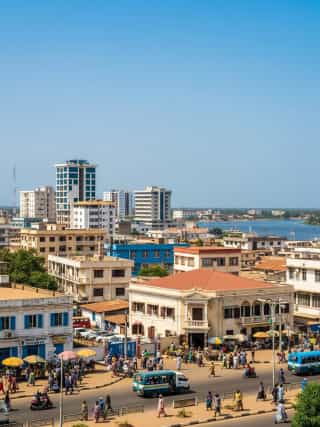
Banjul - The Capital of The Gambia
- Population
- 31,301
- Language
- English
- Continent
- Africa
- Since
- 1816
- Eco Ranking
- 143/195
Source: Environmental Performance Index 2024.
About Banjul
Banjul was founded in 1816 by the British as a trading post and military base on St. Mary's Island at the mouth of the Gambia River, explicitly to suppress the Atlantic slave trade and assert influence in the region. Originally named Bathurst after Henry Bathurst, Secretary of State for the Colonies, it was renamed Banjul after independence in 1973. It became the capital of The Gambia upon independence from Britain in 1965. With a city-proper population of roughly 31,000, Banjul is one of the smallest capital cities in Africa by population, most governmental and commercial activity has effectively migrated to the surrounding Kanifing municipality. The city houses the State House, the National Assembly, and the Supreme Court. The Gambia's political history took a decisive turn when Yahya Jammeh seized power in a coup in 1994 and ruled for 22 years, turning Banjul into the seat of an authoritarian government before being removed in 2017 following an election he initially refused to accept. The Gambia is the smallest country on the African mainland.
About The Gambia
The Gambia is a presidential republic and one of the smallest and most densely populated countries in Africa. After 22 years under Yahya Jammeh's authoritarian rule, the country returned to competitive multiparty politics following the 2016 election of Adama Barrow, who was re-elected in 2021. The country is a narrow strip of territory surrounding the Gambia River, entirely enclosed by Senegal except for its Atlantic coastline.
View Banjul on the map
Flight time from Banjul to other capitals
| City | Distance (km) | Flight Time |
|---|---|---|
| Rome | 4200 | 4h 56m |
| Paris | 4300 | 5h 4m |
| London | 4500 | 5h 18m |
| Cape Town | 6400 | 7h 32m |
| Washington, D.C. | 6500 | 7h 39m |
| Buenos Aires | 6900 | 8h 7m |
| Abu Dhabi | 7500 | 8h 49m |
| Singapore | 13200 | 15h 32m |
| Tokyo | 14000 | 16h 28m |
| Canberra | 17200 | 20h 14m |
Capitals with similar population to Banjul
| City | Population |
|---|---|
| Monaco | 39,244 |
| Port of Spain | 37,074 |
| Apia | 36,735 |
| Banjul | 31,301 |
| Majuro | 28,000 |
| Victoria | 26,450 |
| Nuku'alofa | 23,658 |
Capitals with similar eco ranking to Banjul
| City | Eco Rank |
|---|---|
| Porto-Novo | 141 |
| Ulaanbaatar | 142 |
| Banjul | 143 |
| Accra | 144 |
| Nairobi | 144 |
| Maseru | 144 |
| Port Moresby | 144 |
Source: Environmental Performance Index 2024.
Frequently Asked Questions
Why is Banjul the capital of The Gambia?
Banjul became the capital because it was the administrative center established by the British during the colonial period, originally as a fort and trading post in 1816. When The Gambia gained independence in 1965, Banjul, then called Bathurst, continued as the seat of government and was renamed Banjul in 1973.
Why is Banjul so small?
Banjul is located on a small island at the mouth of the Gambia River, which physically limits its expansion. Much of the population and commercial activity has consequently shifted to the neighboring Kanifing municipality and the Greater Banjul Area. The city proper holds only around 31,000 people.
What was Banjul called before independence?
Banjul was called Bathurst during the colonial period, named after Henry Bathurst, the British Secretary of State for the Colonies at the time of the settlement's founding in 1816. The name was changed to Banjul in 1973, eight years after independence.
Did Banjul play a role in combating the slave trade?
Yes. The British established the settlement specifically to suppress the Atlantic slave trade along the West African coast and the Gambia River. A naval base was stationed there to intercept slave ships, and it served as a liberated African settlement for freed slaves in the early 19th century.
What happened in Banjul in 1994?
In July 1994, a military coup led by Lieutenant Yahya Jammeh overthrew the elected government of Sir Dawda Jawara while he was abroad. Jammeh suspended the constitution, banned political activity, and went on to rule The Gambia from Banjul for 22 years until he lost the 2016 election and was ultimately forced into exile.
Sights and landmarks
Climate and best time to visit
Regional significance
Economy