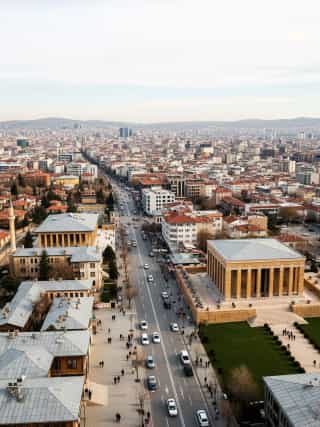
Ankara - The Capital of Türkiye
- Population
- 5,639,076
- Language
- Turkish
- Continent
- Asia
- Since
- 1923
- Eco Ranking
- -
Source: Environmental Performance Index 2024.
About Ankara
Ankara became the capital of the Republic of Turkey on 13 October 1923, a deliberate political decision by Mustafa Kemal Atatürk to break with the Ottoman imperial legacy centered on Istanbul. At the time, Ankara was a modest Anatolian town of fewer than 30,000 people. Atatürk had used it as the base of the Turkish national movement during the War of Independence (1919-1923), establishing a provisional government there in 1920. Moving the capital inland served multiple purposes: it removed the seat of power from a city still under partial Allied occupation and control, reduced dependence on a coastline vulnerable to naval pressure, and symbolically signaled the founding of a new, secular republic rather than a continuation of the sultanate. The Grand National Assembly of Turkey sits in Ankara, as does the presidency and all major government ministries. Istanbul, with approximately 15 million residents, remains far larger than Ankara's 5.6 million, one of the world's most significant mismatches between a country's largest city and its capital. Atatürk's mausoleum, Anıtkabir, is located in Ankara.
About Türkiye
Turkey is a presidential republic following constitutional changes approved by referendum in 2017 and implemented in 2018, which abolished the prime ministerial office and concentrated executive authority in the presidency. The Grand National Assembly retains legislative functions. Turkey is a founding member of NATO and a candidate for EU membership, though accession negotiations have been effectively stalled since 2016. The country spans both Europe and Asia, with Istanbul straddling the Bosphorus strait.
View Ankara on the map
Flight time from Ankara to other capitals
| City | Distance (km) | Flight Time |
|---|---|---|
| Rome | 1700 | 2h 0m |
| Paris | 2600 | 3h 4m |
| Abu Dhabi | 2600 | 3h 4m |
| London | 2800 | 3h 18m |
| Cape Town | 8300 | 9h 46m |
| Singapore | 8300 | 9h 46m |
| Washington, D.C. | 8700 | 10h 14m |
| Tokyo | 8800 | 10h 21m |
| Buenos Aires | 12500 | 14h 42m |
| Canberra | 14500 | 17h 4m |
Capitals with similar population to Ankara
Frequently Asked Questions
Why is Ankara the capital of Turkey and not Istanbul?
Atatürk chose Ankara as the capital in 1923 to break with the Ottoman past and establish a new republican identity. Istanbul had been the Ottoman imperial capital and was partially occupied by Allied forces after World War I. Ankara, deep in the Anatolian heartland, symbolized a fresh start and was more defensible.
When did Ankara become the capital of Turkey?
Ankara was declared the capital of the Republic of Turkey on 13 October 1923, two weeks before the republic was officially proclaimed on 29 October 1923. The Turkish Grand National Assembly had been operating from Ankara since April 1920, during the War of Independence.
Is Ankara the largest city in Turkey?
No. Istanbul is by far Turkey's largest city, with approximately 15 million residents. Ankara has around 5.6 million, making it the second largest. This makes Turkey one of the most prominent examples globally of a country whose capital is not its largest city.
What major government buildings are in Ankara?
Ankara is home to the Grand National Assembly (Turkey's parliament), the Presidential Complex (Cumhurbaşkanlığı Külliyesi), the Constitutional Court, and all major ministries. Anıtkabir, the mausoleum of republic founder Mustafa Kemal Atatürk, is also located in the capital.
Was Ankara always an important city before becoming the capital?
No. Before the Turkish War of Independence, Ankara was a small Anatolian market town with fewer than 30,000 inhabitants, known primarily for its Angora goat wool trade. Atatürk's choice of Ankara as the base for the nationalist government transformed it into a modern planned capital city within decades.
Sights and landmarks
Climate and best time to visit
Regional significance
Culture and customs